


Research, development and innovation is the roadmap for our growth and a founding principle in everything we do. It is and will always differentiate us from our competitors.
For almost four decades our main objective has been to stay one step ahead, explore new paths, innovate and be different. For this reason, R&D&I are for us a commitment to the future. It is a promise to try to solve the main problems that affect the agri-food sector and therefore our society.
Thanks to a large annual investment in research and our professionals in the R&D department, at Fertinagro Biotech we can boast of already having more than 272 technological patents registered nationally and internationally, while we continue to develop essential projects for the adaptation of the farmer to the new regulatory frameworks.
These projects focus on the development of new products and processes that minimize the use of economic resources used in agriculture, placing special emphasis on the development of efficient fertilisers that increase crop yields using renewable resources.

ANNUAL INVESTMENT IN R&D&I

WITH RESEARCH CENTRES

CERTIFIED BY THE CENTRE FOR DEVELOPMENT OF INDUSTRIAL TECHNOLOGY (CDTI) IN THE LAST 15 YEARS

RESEARCH
PROJECTS

AND INTERNATIONAL PATENTS
Fertinagro Biotech
awarded the 2025
National Innovation Award
in the Large Innovative
Company category

Fertinagro Biotech
awarded the 2025
National Innovation Award
in the Large Innovative
Company category
Our constant commitment to research has allowed us to be at the forefront of innovation, having the most complete and advanced agronomic and biotechnological laboratories in the sector, where the fertilisers of the future are developed.
The development of R&D testing is centralized at the C.I.B.A located in Utrillas (Teruel) (Spain) where we have a physical-chemical analysis laboratory and a molecular biology laboratory where our latest acquisitions represent an important revolution in the field of biotechnology. In it we carry out metagenomic studies with which we are able to sequence the genome of the different microorganisms present in the soil and, therefore, see the characteristics of their microbiological composition.
We also have a plant physiology laboratory with NIRS technology for the analysis of raw materials and mineral fertilisers at the Teruel (Spain) plant.


Research as the basis of a good fertilisation strategyn
-
Soil sampling
-
 First, after a preliminary study of the characteristics of the land and the evolution of the crop through remote sensing, soil samples are taken from the plot to be studied.
-
-
DNA isolation
-
 In the laboratory, we homogenize the subsamples, screen them and prepare them for the different analyzes to be carried out, isolating the microbial DNA using specific extraction techniques.
-
-
Sequencing
-
 With the MiSeq massive DNA sequencer, we obtain information on the specific genomic sequences of soil microorganisms to later process them.
-
-
Assembly
-
 Using bioinformatic tools, the results are interpreted and a reliable picture of the diversity and structure of microbial populations is obtained.
-
-
Identification
-
 From the photograph obtained during the previous phases of analysis (sequencing and assembly) we will carry out the interpretation of these results.
-
-
Prescription Nutrient Plan
-
 Thanks to the information obtained in the evaluation of the biological component of the soil, we can design exclusive and high-precision fertilization plans for each specific ecosystem.
-
-
 Active partner of the BIOVEGEN Platform (Technological Platform for Plant Biotechnology)
Learn more > -

-

-
 Member of the CIRCE Foundation (Center for Research on Energy Resources and Consumption)
Learn more >
Innovation, development, and dissemination are key pillars for Fertinagro Biotech. Collaboration with academia and industry drives technological advancement and improves solutions for crops.

Our Fertinagro Biotech-UPM Chair on Soils and Agri-food Systems was presented on September 23, 2025, at the Higher Technical School of Agricultural, Food and Biosystems Engineering of the Polytechnic University of Madrid. Our objective is to gain a better understanding of soil health by analyzing both physicochemical and biological parameters.
We are interested in soil health in relation to:
- Its use and agronomic management, including the recovery of soils degraded by human activities.
- The relationship between soils and agricultural production/food systems (production, quality, health).
- The relationship of soil with fertilization and nutrient cycles.
- The relationship of soil with the environmental sustainability of agroecosystems, including the mitigation of air, surface water and groundwater pollution, as well as carbon sequestration capacity.
Furthermore, we aim to improve the training of our students by collaborating with professionals in the agri-food sector, promoting training activities, dissemination and knowledge transfer, and fostering R&D&I.
“Fertinagro’s collaboration with UPM through this chair will improve our university’s contribution to a healthier, more sustainable and competitive agri-food sector based on soil health.”
Luis Rey.
Director of the Fertinagro Biotech-UPM Chair on Soils and Agri-Food Systems.

The ENIA International Chair in Artificial Intelligence and Agriculture is an initiative of the University of Córdoba that aims to promote research, training, and knowledge transfer on the application of artificial intelligence (AI) in the agri-food and forestry sectors. This chair seeks to integrate technologies such as data spaces, digital twins, predictive systems, and virtual assistants into various crops and ecosystems, including Mediterranean, extensive, woody, and greenhouse crops, with the goal of improving the sector's efficiency, sustainability, and resilience.
This public-private partnership, with funding exceeding €2 million, is promoted by the Ministry of Digital Transformation and Public Administration, along with companies such as Hispatec, Fertinagro, Greenfield Technologies, and Deuser. With a work plan for the period 2023-2027 that includes more than 40 activities, the chair involves 72 researchers from institutions such as the University of Córdoba, the IAS-CSIC (Institute of Agricultural and Forestry Research - Spanish National Research Council), and the University of Melbourne. The integration of the latter and the letters of adherence and commitment signed by Trinity College Dublin, ARS-USDA, UK LEUVEN, UNCUYO, S3P Agrifood T&BD, EDIH Andalucía Agrotech and the Inter-American Institute for Cooperation on Agriculture (IICA), where work has been and is being done for the training of startups (agtech) from the 34 member countries of this entity, make the chair a global benchmark in agri-food innovation and digitalization.
“For the University of Córdoba, the ENIA International Chair in Artificial Intelligence and Agriculture is more than just a project; it's a shared platform where research, training, and business come together to bring AI closer to the agri-food and forestry sectors. We work around four technical areas: predictive models, data spaces, digital twins, and virtual assistants, with the aim of facilitating the sector's technological transition so that the companies and institutions that comprise it become even more sustainable, more competitive, and with a greater international presence.”
Rosa Gallardo.
Director of the International ENIA Chair on Artificial Intelligence and Agriculture (CIIAA).
The Fertinagro-Biotech Chair of Agri-Food Sustainability at the University of Huelva has the following main lines of action:
- Transforming the agri-food sector so that its activities are neutral or positive in terms of climate change and the production of healthy and sustainable food.
- Transforming rural areas towards inclusive, high-quality, and value-added employment, by promoting the environmental management of agriculture.
- Reducing food waste throughout the entire food chain.
To achieve these objectives, activities are geared towards the three fundamental pillars of the University: education, research, and knowledge transfer.
“For the University of Huelva, the establishment of External Chairs aims to strengthen the relationship between the university community and its social, institutional, and business environment, contributing to the generation and dissemination of knowledge and the training of future professionals in areas of common interest. In this case, the Fertinagro-Biotech Chair of Agri-food Sustainability intends to cover a very important area within the province's economic sector, namely the agri-food sector.”
Luis Zarazaga.
Director of the Fertinagro Biotech-UHU Chair on Agri-Food Sustainability.

The Tervalis Chair of Bioeconomy and Society at the University of Zaragoza was established in 2017. By creating a collaborative bridge between the University of Zaragoza and the Tervalis Group, a framework was generated that integrates the academic and business worlds. This Chair will change its name to the “Fertinagro Biotech Chair of Bioeconomy and Society” in 2025.
The Fertinagro Biotech Chair of Bioeconomy and Society addresses sustainability transitions and their impact on the primary sector; human health and healthy and sustainable environments (food security, emotional well-being related to the environment); sustainability, energy culture and ecological awareness; social perception, public opinion and changes in habits and values (climate change, eating habits, production and consumption patterns, responsible and sustainable consumption). It promotes education and knowledge (in society) about the bioeconomy; supports doctoral theses and undergraduate and master's degree projects; It promotes knowledge development by awarding prizes, scholarships, and calls for micro-research projects; establishes and disseminates best practices; fosters institutional relationships and collaborative networks, creating a leading forum for debate; and coordinates and promotes university scientific and technological capabilities and developments related to the bioeconomy. The chair, uniting the vocations of its constituent entities, stands out for its strong commitment to attracting talent to the region.
“Since its creation, this chair has stimulated academic and scientific development within the university community, highlighting the importance of transferring all the research and innovation it fosters. Furthermore, it contributes to creating job opportunities for graduates in the region”.
Alexia Sanz.
“Director of the Térvalis Chair on Bioeconomy and Society at the University of Zaragoza.”
The Fertinagro Biotech Chair of Agricultural Biotechnology – Universitat Politècnica de València (UPV) aims to strengthen collaboration between the university and the agri-food sector to promote innovation, knowledge transfer, and talent development in the field of sustainable agriculture.
Its activities focus primarily on three areas. First, the transfer of scientific and technical knowledge to the agricultural sector through technical workshops, seminars, and professional meetings aimed at technicians, farmers, and other stakeholders in the sector. Second, the dissemination and promotion of innovation within the university environment, fostering interaction between students, faculty, and industry.
Finally, the chair promotes internship programs for students, enabling them to develop projects linked to real-world challenges in the agricultural sector and facilitating practical training.
“The Fertinagro Biotech – UPV Chair in Agricultural Biotechnology is a prime example of university-industry collaboration aimed at generating knowledge with a real impact on the agri-food sector. Through this initiative, the Universitat Politècnica de València (UPV) reinforces its commitment to knowledge transfer, bringing scientific advances closer to the professional and productive sphere. The chair also contributes to creating spaces for interaction between researchers, students, and professionals in the sector, fostering knowledge exchange and the generation of new innovation opportunities. Furthermore, it offers students the chance to participate in internship programs and technical activities linked to real-world agricultural challenges. All of this strengthens the practical training of future professionals and improves their connection with the business community. Overall, this collaboration with Fertinagro Biotech helps consolidate the UPV's role as a leader in applied research, technological innovation, and sustainable development in the agri-food sector.”
Vicente Estruch.
“Director of the Fertinagro Biotech Chair on Agricultural Biotechnology – Polytechnic University of Valencia (UPV).”

Billions of microorganisms working for you
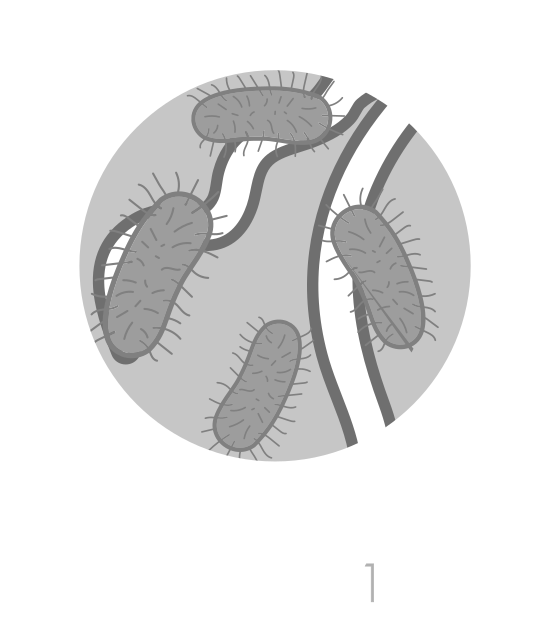
ACTIVE AND INCREASE THE DIVERSITY OF AZOTOBACTER, PSEUDOMONAS AND BACILLUS POPULATIONS AT THE LEAF AND SOIL LEVEL

AZOTOBACTER ACHIEVES AN EFFECT OF FIXATION AND ASSIMILATION OF ATMOSPHERIC NITROGEN IN A NATURAL WAY

PSEUDOMONAS AND BACILLUS UNBLOCK AND SOLUBILIZE LARGE AMOUNTS OF PHOSPHORUS AND POTASSIUM PRESENT IN THE SOIL

INCREASED BIODIVERSITY CONTRIBUTES TO THE DEVELOPMENT OF SUPPRESSIVE SOILS, REDUCING THE IMPACT OF PESTS AND DISEASE


